


What is a Synthetic Audience and How Does it Work?


What Is a Synthetic Audience? Every big decision about people used to come down to an educated guess. Will they buy it, subscribe, click it, believe it? We've seen what can go wrong again and again: large campaigns fall flat, hit the wrong tone, or draw a backlash that leaves puzzled managers unable to explain why they didn't see it coming.
But who's to blame? It's easy to say the brands weren't thinking, but the more honest answer is that humans are hard to predict, and these moments simply highlight when guessing how your customer will respond goes spectacularly wrong.
At Electric Twin, we're on a mission to change how research works, because we believe current methods are slow, costly, and often inaccurate. We're building synthetic audiences that make it possible to ask your customers what they really think, so that decisions get made on evidence instead of guesses.
This goes beyond speed and cost. Synthetic audiences let you iterate on questions, dig into a surprising answer, and go again. They bring your customer to life, making unwanted surprises less common and failed launches a thing of the past.
What Traditional Research Methodology Gets Wrong
Most traditional quantitative methods still sort people by demographics. They capture things like age, gender, religion, income, and postcode. Those categories have run marketing and polling for generations, largely because they're what the census collects and passes down. Because that data is widely available, it's become the baseline for how we model behaviour. Their ubiquity creates the impression that these markers matter in predicting people, when in truth they're a by-product of an outdated methodology.
Imagine two people who share the same age, gender, income bracket, and postcode. How likely are they to buy nappies? On demographics alone you can't say, because you're missing the most important factor: whether they are a parent. Demographic data won't tell you that. Context and cultural background are key.
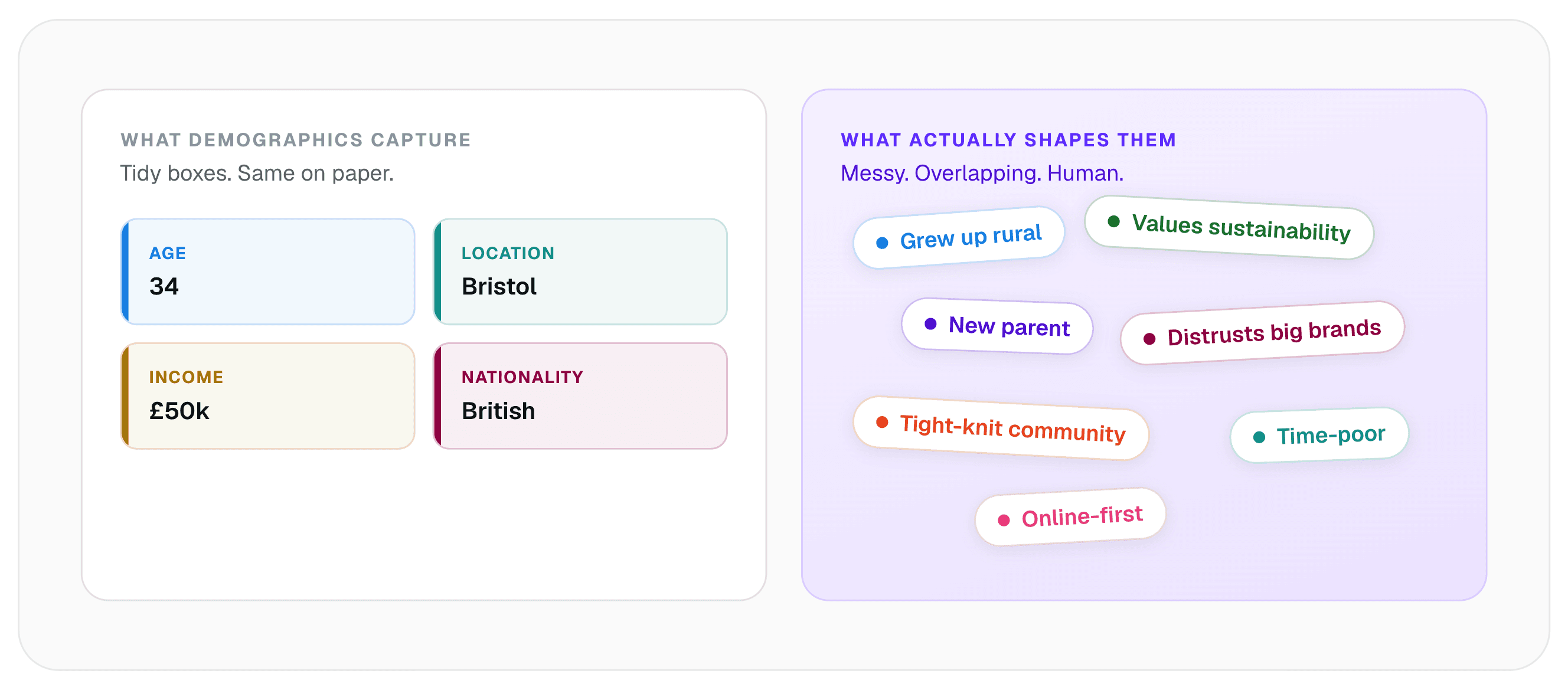
Build a synthetic audience on demographic labels alone and you get a stereotype in a clean interface. Convincing on the surface, wrong underneath.
How a Good Model Works
A good model works by taking customer data and using their responses to predict what a customer would say next. It goes deep on preferences and behaviour, capturing what people believe and value rather than the boxes they tick.
This is also what separates Electric Twin from other LLMs: the ability to find the outliers in your respondents, not just the average. A state-of-the-art LLM trains on all data it can find, so that it ends up asking everyone, with no way to anchor it to the specific person you actually care about.
Because ET builds personas from real data, we're able to segment out exactly what each respondent would say, helping you catch outliers and detractors at a 96% accuracy rate. Our model isn't designed to give the best-sounding answer; it's designed to extract the precise one.
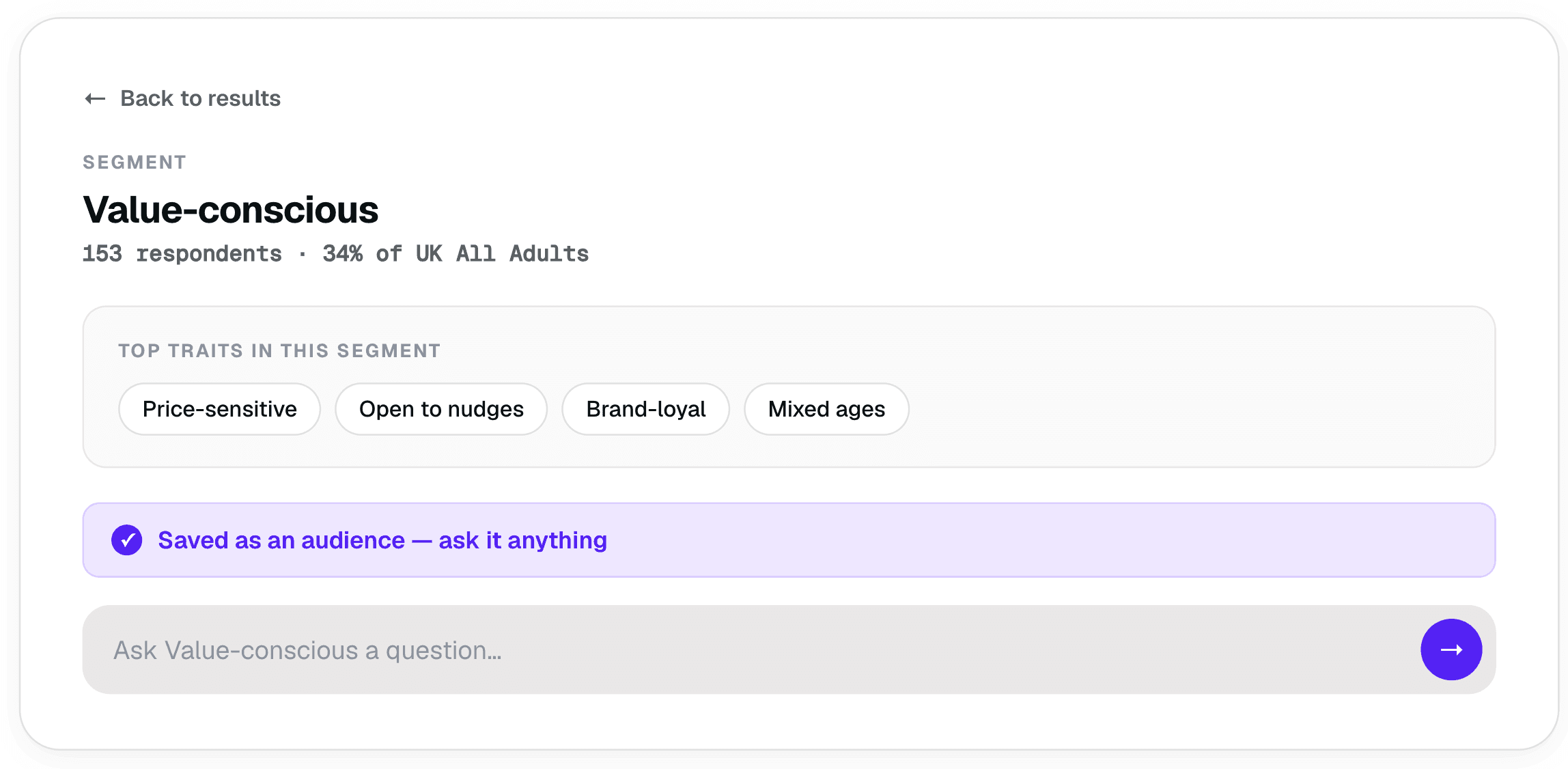
The Impact
A synthetic audience model that goes beyond demographics lets you dig deeper into who your customers really are. It opens up what you can test: ideas too small for a full study, audiences too niche to reach any other way, and questions you can ask on repeat, so that decisions about people are made with evidence, instead of generalisations and stereotypes.
At Electric Twin, we want to make it possible to know your audience deeply, with a living audience platform that behaves like the real thing.
Want more like this?
Want more like this?
Insight delivered to your inbox
Keep up to date with our free email. Hand picked whitepapers and posts from our blog, as well as exclusive videos and webinar invitations keep our Users one step ahead.
By clicking 'SIGN UP', you agree to our Terms of Use and Privacy Policy

By clicking 'SIGN UP', you agree to our Terms of Use and Privacy Policy
Other content you may be interested in




Want more like this?
Want more like this?
Insight delivered to your inbox
Keep up to date with our free email. Hand picked whitepapers and posts from our blog, as well as exclusive videos and webinar invitations keep our Users one step ahead.
By clicking 'SIGN UP', you agree to our Terms of Use and Privacy Policy
Brought to you by
